
This post touches on a health topic. Please read it closely.
Bone is living tissue, and it responds to load much like muscle does. That is the short version of why strength training belongs in any conversation about bone density after 50.
The longer version starts with a number. According to CDC data from its national health survey, 12.6 percent of US adults 50 and older have osteoporosis, including 19.6 percent of women and 4.4 percent of men. Another 43.1 percent have low bone mass. Put together, more than half of adults in that age group have bones that are thinner than they should be.
Low bone mass does not hurt. Many people only hear about it after a scan, or after a fall that should have been minor.
Why bone density matters more than it seems
The real concern with thinning bones is fractures. The Bone Health and Osteoporosis Foundation estimates that roughly 1 in 2 women and up to 1 in 4 men age 50 and older will break a bone due to osteoporosis in their lifetime.
That risk shows up in ordinary moments. In Metro Detroit, the first measurable snowfall arrives around November 16 on average, according to National Weather Service Detroit records. So right about now, driveways, parking lots, and the sidewalks along Woodward start to get slick, and a slip carries more weight when bones are fragile.
It also shows up in the things you want to keep doing, like pulling grandkids up the sledding hill at Normandy Oaks Park or a long day on your feet at the Detroit Zoo. Those outings ask your legs, hips, and spine to handle load. Training prepares them for it.
What the research says about lifting and bone
For years, the standard advice for people with low bone mass was to keep exercise gentle. A 2018 randomized trial called LIFTMOR tested that assumption directly.
Published in the Journal of Bone and Mineral Research, the trial followed 101 postmenopausal women with low bone mass for 8 months. One group did high-intensity resistance and impact training, twice a week for 30 minutes. The other group did a low-intensity program.
The results:
- The high-intensity group improved lumbar spine bone mineral density by 2.9 percent.
- The low-intensity group declined by 1.2 percent over the same period.
- The high-intensity group also saw benefits at the femoral neck, the top of the thigh bone near the hip.
Two things stand out. The gentle program did not hold the line; that group lost ground. And the sessions were short: an hour a week of focused work moved the needle.
This is one trial in one group of women, not a promise for every body. But it is a strong sign that bone needs a meaningful challenge to respond.
Why supervision was part of the result
Here is the detail that often gets left out: every LIFTMOR session was supervised. The researchers did not hand participants a program and wish them luck. Heavy loading with low bone mass was done with an expert watching form and deciding when to add weight.
The benefit and the risk come from the same place: bone responds to load, and load done poorly is how people get hurt. Supervision makes the heavier end of the spectrum reasonable.
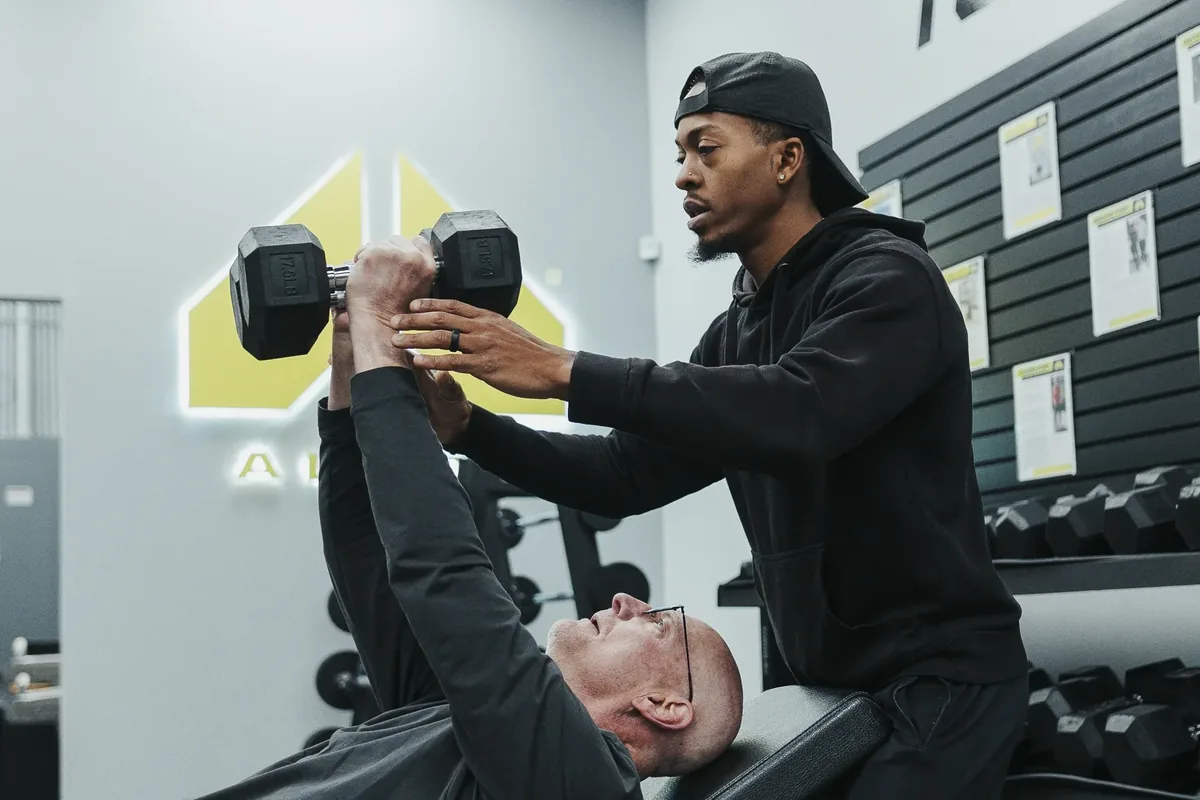
This is the model small group training at Alloy is built on. Each session is capped at six members and led start to finish by a certified personal trainer, and each member follows an individualized program based on their goals, history, and current level. Your coach adjusts and progresses every exercise, so the load goes up when you are ready, not before.
What safe progressive loading looks like
If you have been diagnosed with osteoporosis or low bone mass, talk with your doctor or physical therapist before you start, and bring any movement guidance they give you to your coach. Good training works inside those limits.
From there, a coached approach usually looks like this:
- Start with an assessment. A coach checks mobility, imbalances, and limitations before adding weight.
- Learn the patterns first. Squats (often a goblet squat), hip hinges, presses, rows, step-ups, and carries like the farmer carry.
- Add load gradually. Weight increases in small steps as form stays solid, week over week.
- Train balance alongside strength. Strong legs and steady footing work together on a winter sidewalk.
If lifting is new to you, our beginner's guide to strength training in Royal Oak covers what the first few weeks feel like.
InBody scans and DEXA scans measure different things
It is easy to mix these up, so here is the plain distinction.
A DEXA scan, ordered through your doctor, measures bone mineral density. It is how osteoporosis and low bone mass are diagnosed, and it is the test to ask your physician about, whether you see someone at Corewell Health William Beaumont University Hospital or at a practice closer to home.
An InBody scan measures body composition: muscle mass, body fat percentage, and other key metrics. It does not measure bone density. What it does show is whether you are building muscle over time, which is useful for tracking the training that supports your bones.
What should your first step be?
If bone density is on your mind, start with your doctor, then start with a plan. At Alloy Royal Oak, the first visit is a Complimentary Session: a one-on-one conversation with a trainer about your goals, health history, and training experience, a functional movement assessment, an InBody body composition analysis, and an introductory workout scaled to you. No pressure, no obligation.
The studio is on Woodward Avenue, and members come from Royal Oak and nearby Berkley, Clawson, Huntington Woods, Ferndale, and Birmingham. You can read more about the first visit here.
Book Your Complimentary Session.