
Arthritis is one of the most common reasons adults over 40 stop lifting, or never start. About 53.2 million US adults, roughly 21 percent, had diagnosed arthritis in 2019 to 2021, and adults 45 and older made up 88 percent of them, according to the CDC.
So if your knees complain on the stairs or your hands ache on cold mornings, you have plenty of company. The common instinct is to protect the joint by resting it. The research points the other way, with one important condition: the training has to be the right kind, at the right dose.
Does strength training help arthritis or make it worse?
For most people with osteoarthritis, the evidence favors movement. The 2019 guideline from the American College of Rheumatology and the Arthritis Foundation strongly recommends exercise as a first-line treatment for knee, hip, and hand osteoarthritis.
The CDC has made a similar point. Agency leadership has said physical activity can reduce arthritis pain and improve function by almost 40 percent. Results vary person to person, and nobody can promise a specific outcome, but the direction of the evidence is clear.
Strength work matters here because muscle is the joint's support system. Stronger quads help control the knee on the way down a step. Stronger hips and glutes share the load when you stand up from a low chair. When the muscles around a joint do more of the work, everyday movement can get easier to manage.
Trouble usually comes from lifting too much, too fast, through a range the joint is not ready for, with nobody watching.
What coached strength training looks like with sore joints
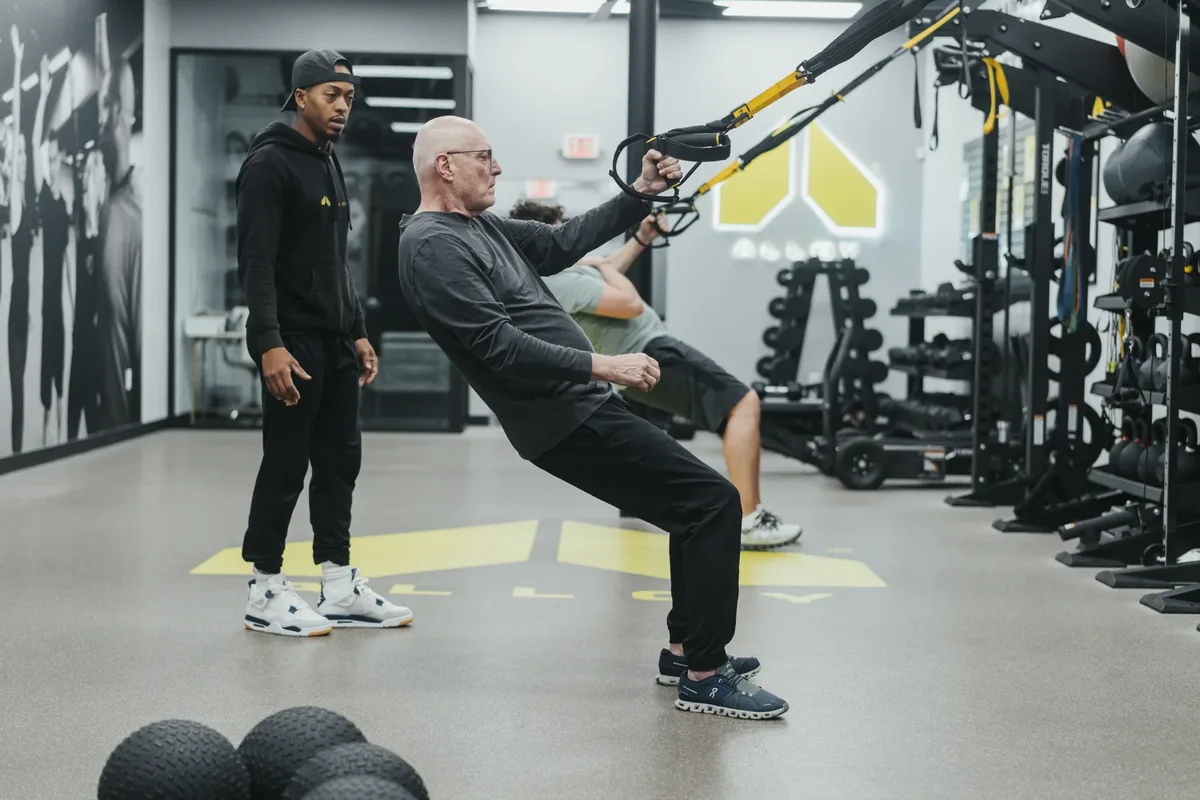
Good training with arthritis starts with finding out what your joints can do today. That is the purpose of a functional movement assessment: before training begins, a coach checks your mobility, imbalances, and limitations, so the program fits the body you actually have.
From there, the exercises are familiar. They are just set up thoughtfully:
- Squats to a target. A goblet squat down to a bench or box lets you control depth, and the box can be raised or lowered as the knee tolerates.
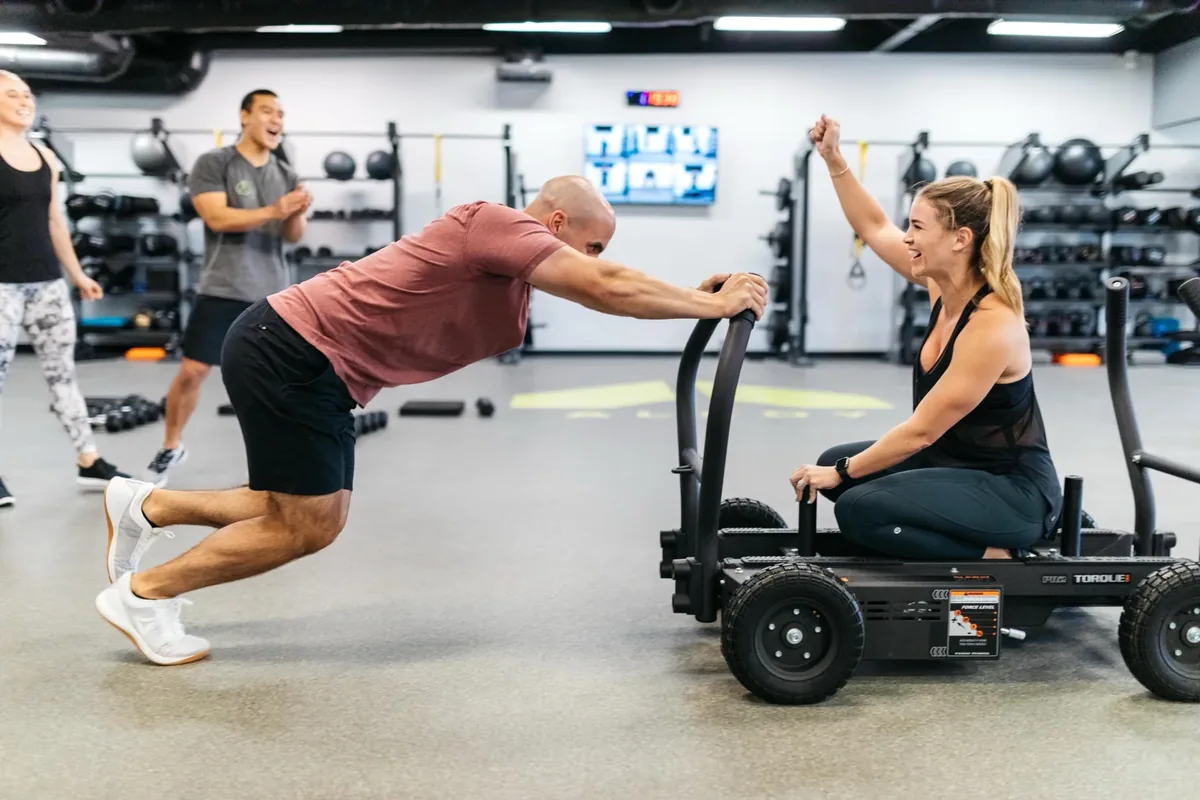
- Sled pushes. No impact and no deep bending, but real work for the legs and hips.
- Farmer carries. Walking with weights in each hand builds grip, posture, and leg strength. Hand arthritis? Thicker handles or lighter loads can help.
- Low step-ups. A modest step height trains the exact motion of climbing stairs.
- Cables and machines. A steadier path of motion often feels better on cranky shoulders and wrists than free weights, at least at first.
Progress is slow and deliberate. Coaches add a little weight, a few reps, or a bit more range over weeks, not all at once.
How coaches adjust on a flare day
Arthritis is not the same every day. Some mornings a knee feels fine; other days it is swollen and stiff. A good program bends to that instead of forcing the plan.
On a flare day, a coach might shorten the range of motion, swap a squat for a sled push, lighten the load, or shift the session toward the upper body and core. The goal is to keep you moving without aggravating the joint. Many coaches use a simple rule: mild discomfort that settles quickly is usually acceptable, while sharp pain or pain that lingers into the next day means the dose was too high.
One honest note: arthritis comes in many forms, and inflammatory types like rheumatoid arthritis need different handling than osteoarthritis. If you have arthritis, loop in your doctor or physical therapist before you start, and keep them in the conversation as you progress. If you already see a physical therapist, perhaps at Corewell Health William Beaumont University Hospital here in Royal Oak, a coach should work alongside that guidance, not around it.
Why Michigan winters make this more urgent
Cold, stiff joints and slick sidewalks are a tough combination. The Detroit area's average first measurable snowfall arrives around November 16, according to National Weather Service climate data. Once the ice shows up, a lot of people with sore knees simply stop walking outside, and the joints get stiffer from the inactivity.
Keeping some movement on the calendar helps. The Royal Oak Farmers Market runs indoors on Saturdays year-round, which makes it a reasonable winter walk with a destination. When the weather turns again in spring, the paved trails at Normandy Oaks Park are a flat, steady option for rebuilding walking volume.
Strength training fills the gap in between. Leg strength and balance built indoors through the winter carry into those first spring walks and into tasks that do not stop for weather, like shoveling the driveway.
What should your first step be?
The first visit at Alloy Personal Training Royal Oak is a Complimentary Session. It starts with a one-on-one conversation with a trainer about your goals, health history, and training experience, which is the right time to talk through which joints bother you and what your doctor or physical therapist has said. You will also go through a functional movement assessment, an InBody body composition analysis, and an introductory workout scaled to you. There is no pressure and no obligation.
Training happens in small groups capped at six members, each on an individualized program that a certified personal trainer adjusts session by session. Our post on personal training over 50 in Royal Oak explains how that works in more detail.
The studio is on Woodward Avenue, and members come from Royal Oak and nearby Berkley, Clawson, Huntington Woods, Ferndale, Pleasant Ridge, Oak Park, and Birmingham. When you are ready, Book Your Complimentary Session.